Albula Pass Driving Guide: A Proper Escape into the Engadin
Discover Albula Pass through its railway scenery, mountain bends and lakeside stops, with practical advice for the crossing and a relaxed return via Julier.
Some Alpine roads announce themselves with a wall of hairpins. Albula takes a little longer to make its case. A decorated village, a flash of red train between the trees, a valley that gradually runs out of forest: the scenery changes in chapters, and the road gives you time to notice.
Then you emerge above the trees. Rock replaces woodland, the sky gets bigger and the Upper Engadin waits on the other side. You have crossed a mountain rather than simply climbed to a viewpoint. For a modest stretch of tarmac, Albula delivers a remarkably complete day out.
This guide follows the pass from Bergün through Preda to La Punt Chamues-ch, with the stops, seasonal checks and route choices that make the journey work. Bring whichever well-maintained car you enjoy driving. Albula has enough personality without demanding that your bonnet carries a particular badge.
Albula Pass: the route at a glance
Location: Graubünden, eastern Switzerland. The crossing links Bergün in the Albula Valley with La Punt Chamues-ch in the Upper Engadin.
Summit and distance: 2,312 metres above sea level; approximately 23 kilometres between Bergün and La Punt. Longer distances quoted elsewhere may start farther down the valley. Add Filisur, a museum visit or an Engadin detour and your day quickly becomes much more than a pass crossing.
Time to allow: Reserve at least half a day for the road, lake and village stops. That is our touring recommendation, not a predicted driving time. A full day gives you room for railway heritage and a return via Julier.
Access: A paved, seasonal mountain road with narrow sections and variable surfaces. Check the Graubünden road report before departure. A summer date alone does not confirm that the whole crossing is open.
What the road feels like, section by section
Bergün to Preda: village life gives way to railway country
Bergün deserves more than a windscreen inspection. Park for a short walk and the painted façades, village scale and railway setting make the landscape easier to understand. This is a place people live in, with deliveries, pedestrians and everyday traffic sharing the route you have come to enjoy.
Beyond the village, the climb becomes more involved. The road follows the valley towards Preda while the railway repeatedly solves the gradient in its own way. Bridges and tunnels are part of the scenery, although you should not expect every landmark to appear conveniently beside a parking bay. Let the passenger watch for trains; the driver has corners to read.
This lower section suits a compact car with good visibility. On narrower stretches, leave room to meet an oncoming vehicle without a theatrical last-second shuffle. The satisfying part is placing the car accurately and keeping the journey calm. Excess power contributes surprisingly little when the next useful piece of road disappears around a rock face.
Preda to the summit: the landscape opens
Past Preda, the road rises towards Lai da Palpuogna and the exposed upper crossing. Woodland gradually thins, the views lengthen and the road's character changes again. The scenery can look spacious while the available carriageway remains quite modest, so judge each section by what you can actually see.
Surface quality deserves attention. Winter weather and maintenance leave their mark on Alpine roads, and Albula should not be sold as uninterrupted showroom-smooth asphalt. A comfortable suspension setting often makes more sense than the firmest mode available. Your passenger, camera equipment and lower back may reach the same conclusion.
Down to La Punt: a different valley
The eastern descent brings the Upper Engadin into view. Allow time to stop where parking is permitted, then concentrate on the bends ahead rather than trying to collect the panorama through the side window. Arriving in La Punt feels like entering a new chapter: broader valley views, Engadin houses and several tempting directions for the afternoon.
The descent also explains why a small mountain distance can take real concentration. Choose an appropriate gear or downhill setting before speed builds, follow the car's operating guidance and keep your braking measured. A good run should feel composed from both front seats.
-main.jpg)
When to drive Albula Pass
Plan Albula as a summer or early-autumn drive, with flexibility at both ends of the season. Snow clearance, fresh snowfall, maintenance and local restrictions determine access. Check the complete route shortly before travelling, then look again on the morning you leave. A road open to Preda is not the same thing as an open crossing into the Engadin.
For a first visit, a clear summer weekday gives you a sensible starting point. Earlier departures can help with parking and leave more daylight for stops, but dawn is not automatically the best driving window. Cold shaded bends, low cloud and tiredness after a long approach can outweigh the appeal of an empty photograph.
September can be particularly attractive when the forecast is settled. Later autumn may bring beautiful larch colour around the lake, but also shorter days and less predictable conditions higher up. Decide whether you are planning a photographic outing, a walking day or a relaxed crossing, then choose conditions that suit that purpose.
Keep a lower-level alternative in the itinerary. If the upper road disappears into cloud, spending longer in Bergün is a better use of the day than climbing purely to prove that you reached a summit sign. The pass will not issue a certificate for persistence.
The stops that make Albula worth a whole day
Bergün and the Albula Railway Museum
The Albula Railway Museum, beside Bergün station, gives the route a useful introduction. Its exhibitions explain the railway, its construction and the people connected with it. Check current opening hours and decide in advance whether this is your main visit or a shorter addition to the drive.
Pair it with a village walk rather than stacking another attraction immediately afterwards. If someone in your group is less interested in cars, this is where the trip gains another dimension. Engineering, architecture and a proper lunch are a convincing supporting cast for a mountain road.
Preda and the changing railway landscape
Preda is a useful pause before the upper pass. It is also where the railway heads into the mountain, while your route continues over it. The new Albula tunnel entered service in June 2024, so descriptions of the area as an unchanged historic railway scene miss an important part of the story.
Look at the infrastructure from public areas and follow signs around railway property. Preda works best as a place to notice how the route functions, rather than an invitation to wander towards tunnel portals for a closer picture.
Lai da Palpuogna: leave time to walk
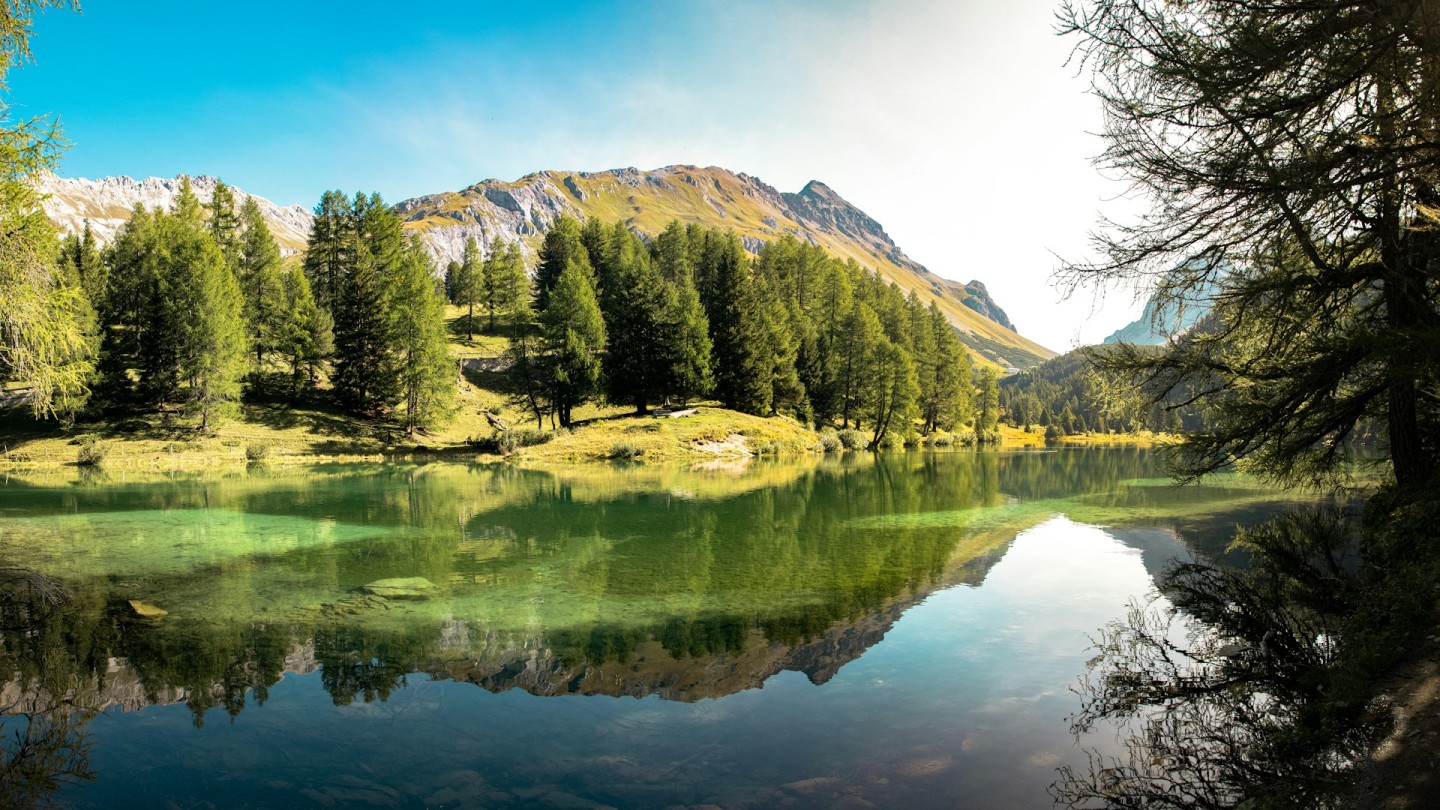
Lai da Palpuogna, also called Palpuognasee, is the lake above Preda on the western side of the pass. Trees, clear water and the mountain backdrop make it an obvious stop, but its appeal improves considerably when you put the phone away for a few minutes.
Use authorised parking and allow time for the approach on foot. Comfortable shoes are a better choice than treating the shore as an extension of the car park. Follow local signs and the paths provided; this is not a swimming stop. The tourism information specifically identifies the lake as unsuitable for swimming.
If parking is full, continue to a suitable alternative rather than creating a new space on a verge. For a group, agree this possibility beforehand. It is much easier to change one stop than to untangle several cars blocking a narrow access.
The summit and La Punt Chamues-ch
At the top, the reward is the open landscape. Step out, put on a layer and take in the difference from Bergün. Plan food and refreshments around confirmed opening times rather than assuming every mountain business operates whenever the road does.
La Punt makes a pleasant finish or lunch stop. Walk a little before continuing deeper into the Engadin: the houses and valley setting deserve attention beyond their role as a turning point on the navigation screen. If you are staying nearby, reaching the valley with time to spare is one of the pleasures of the trip.
Road and railway: what the UNESCO connection actually means
The Rhaetian Railway in the Albula/Bernina landscapes received UNESCO World Heritage status in 2008. The designation concerns the railway and its cultural landscape; it does not turn the pass road itself into a separate UNESCO-listed driving attraction.
That distinction does nothing to reduce the interest. Railway engineers use tunnels, viaducts and carefully arranged climbing sections to gain height. Road engineers have different constraints, and following both routes through the same landscape gives you a fascinating comparison without needing a technical qualification.
If the famous Landwasser Viaduct is on your list, treat it as a separate stop near Filisur, before or after the crossing. It is not at the Albula summit. The official visitor information explains access and notes limited parking. Build in walking time instead of expecting the iconic view from the driver's seat.
An overnight stay also makes a separate train excursion possible. Check the railway timetable and plan how you will return to the car. Driving one day and taking the train another reveals different parts of the valley, particularly for passengers who spent the crossing helping with navigation.
Which direction should you choose?
For a first visit, our pick is Bergün to La Punt. The progression from village and railway landscape to exposed summit, then into the Engadin, gives the day a natural shape. It also makes Bergün an easy place to begin with coffee and a plan before the concentrated driving starts.
La Punt to Bergün works equally well if you are already staying in the Engadin. Your climb begins from the higher valley, and the railway scenery arrives during the descent. There is little value in adding a long repositioning drive simply to follow somebody else's preferred direction.
Choose around weather, accommodation and the stops that matter to your group. A museum opening time or lunch reservation can be more useful than an abstract argument about which side has the better corners. Neither direction guarantees lighter traffic or better light at every viewpoint.
A practical Albula and Julier day
Morning: Begin in Bergün, with the museum if it is central to your plans, or arrive after a pre-planned Landwasser stop near Filisur. Have enough fuel or battery charge for the complete outing. Allow the morning to run a little slowly; rushing the village to save ten minutes usually feels like a poor bargain later.
Late morning: Climb through Preda, walk at Palpuogna and cross the summit. Keep the lake visit optional if conditions, parking or the group's energy suggest otherwise. Reach La Punt ready for lunch rather than immediately committing to another pass.
Afternoon: For a loop, continue through the Upper Engadin towards Silvaplana, then cross Julier towards Bivio and Tiefencastel. From there, route back towards Filisur and Bergün if that is where you started. Enter those waypoints explicitly so navigation follows the intended circuit.
This is a full touring day with stops, not a promise that every attraction fits comfortably. A longer museum visit may justify staying in the Engadin and saving the return for tomorrow. Julier also needs its own road and weather check; it should not become an unquestioned fallback simply because Albula is seasonal.
For a longer Swiss holiday, separate Graubünden from the central-Alpine cluster around Andermatt. Our Oberalp Pass guide explains the crossing between the Surselva and Andermatt. Albula and Oberalp can belong to the same holiday, but they are not adjacent passes to squeeze together between lunch and dinner.
Choosing and preparing the car
A normal road car in good condition is enough. Compact dimensions, predictable brakes and suspension that tolerates uneven surfaces often matter more than acceleration figures. A lightweight roadster can be delightful, but so can a comfortable hatchback that leaves everyone fresh enough to enjoy the stops.
For a classic, have cooling, tyres and brakes checked before the trip if their condition is uncertain. Bring the equipment and assistance details appropriate to your car. The goal is to enjoy an older machine in a fitting setting, not to turn the summit into an improvised workshop.
Very low sports cars deserve extra thought about patched surfaces, drainage edges and parking access. Review restrictions if travelling with a large vehicle: TCS advises against Albula for motorhomes and caravans. Do not assume that a generic navigation route establishes suitability for your exact vehicle.
EV drivers should plan charging around the wider valley itinerary, with a confirmed backup and enough reserve for a diversion. Check connector type, access hours and current operation. Regeneration on the descent can be useful, but its availability depends on the car and battery conditions; it cannot be treated as a guaranteed refund for the climb.
Before setting off, save the route offline, carry water and layers, and make sure the windscreen is clean. Agree who navigates and where you can regroup. On a narrow mountain road, a missed turn is a reason to continue to a safe place, not an instruction to stop immediately.
Photography, passengers and a better driving day
Albula offers several different photographs: village detail, red railway stock, lake reflections and open mountain scenery. Choose two or three subjects instead of trying to stop at every view. That gives the drive a rhythm and makes the photographs more varied.
Keep the camera work separate from driving. Park legally, walk to a safe position and leave carriageways and passing places clear. A photograph taken from above may require a substantial walk or specialist permissions; the composition alone does not prove there is easy public access.
For passengers prone to motion sickness, keep inputs gentle and breaks frequent. Avoid giving them a phone full of route research to read through the bends. A shorter day with a good lake stop will usually be remembered more fondly than a larger mileage total endured from the back seat.
Build your next road trip with Petrolbase
Albula is an excellent independent drive, and it can also inspire a guided weekend or a longer touring holiday. Explore driving tours and road rallies on Petrolbase when you want help with the organisation. Read each itinerary for the actual roads, vehicle arrangements and daily distances; an Alpine tour does not automatically include Albula.
The most useful package is the one that matches how you want to travel: your own car or a supplied vehicle, time to stop or a longer daily route, one base or a different hotel each night. Look for clear inclusions and a sensible approach to weather changes.
For Albula itself, keep the plan generous. Give Bergün a little time, walk beside Palpuogna and let the arrival in the Engadin be part of the reward. You will still enjoy every bend. You will simply come home remembering more than the bends.
Frequently Questions People Ask
Do you have any questions?
-thumb.jpg)